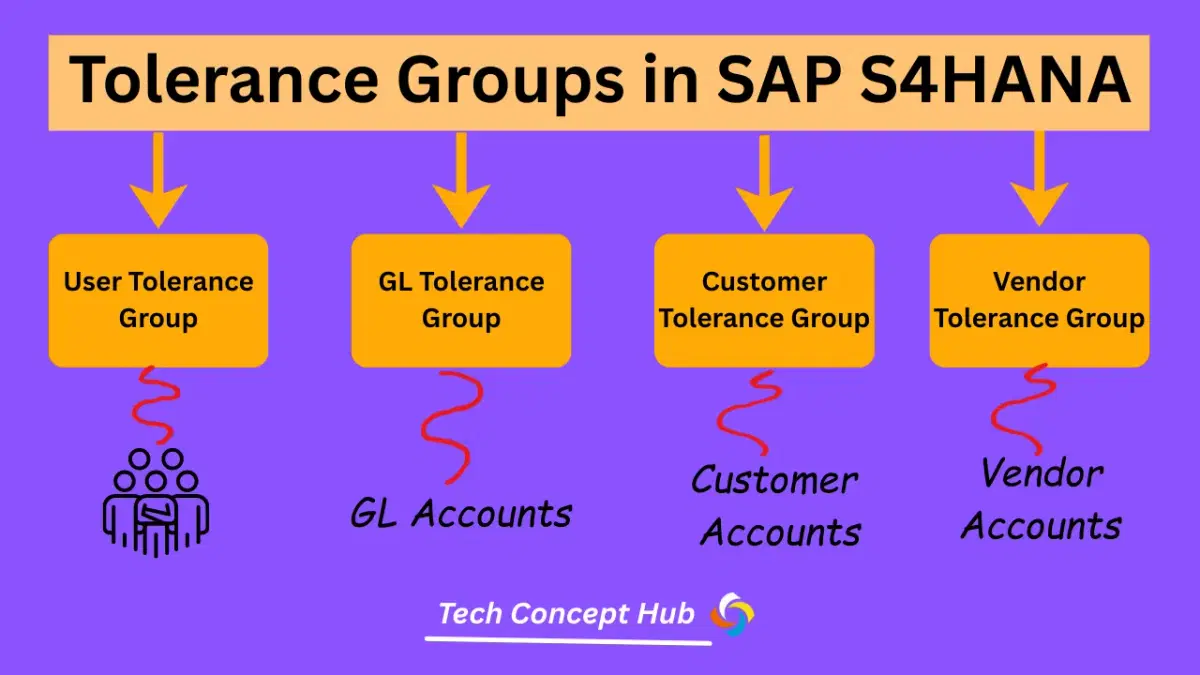
What's the difference between Employee tolerance, GL tolerance, Customer tolerance and Vendor tolerance in SAP S4HANA. Explained in simple words with example
Let's understand the purpose of each type of tolerance in sap with example.
What is Employee Tolerance Group?
What is tolerance? Tolerance means limit. You are giving a minimum and maximum limit within which you accept, anything beyond this limit you will reject.
What is Employee Tolerance Group? Maximum transaction amount that a particular employee is allowed to post in sap. Maximum discount that a particular employee is allowed to give to any customer. Example: If an employee is given maximum transaction limit of 10 lakhs and maximum allowed discount of 5% then this employee can not post a transaction of more than10 lakhs and can not give a customer discount of more than 5%.
Employees are assigned to employee tolerance group also referred as User Tolerance Group. This employee tolerance group is having maximum transaction limit and maximum discount limit.
What is GL tolerance group?
As explained earlier tolerance means maximum limit. Here it's about limit for GL clearing differences. Normally debit and credit balance is equal and clearing takes place. Debit & Credit offset each other and GL open item is cleared successfully. But what if debit and credit balance in GL is not equal, then how will clearing happen? Where does the difference amount go? Example: If you have an Open item managed GL account for which clearing is needed. In the GL, There is debit balance of 100 and credit balance of 102. Now for clearing to happen I can configure sap to accept the maximum difference of 5 and post this difference to another GL account 'clearing differences account'. Since in this case difference is 2 which is less than maximum permission difference (GL tolerance limit) hence difference of 2 will get posted to GL account 'clearing differences account' automatically. If debit & credit difference is more than 5 (my limit) then clearing will not happen and error message will come "difference is too large for clearing".
Multiple GLs are assigned to same GL tolerance group. This tolerance group is given tolerance limit.
What is Customer tolerance and Vendor tolerance?
If customer payment amount is different from invoice amount, then should I accept the payment and clear the customer. I will clear the customer invoice if difference is not too big. If payment amount is very less than invoice amount then I will not allow invoice clearing. Example: Imagine customer open invoice amount is 10 lakhs. Customer made payment of 9,99,990 then I will clear the invoice. Difference of 10 is too small and it will go to 'Customer Discount GL' automatically. Now imagine same invoice of 10 lakhs but customer paid only 9,50,000. I will not clear the invoice because 50,000 difference is too big to ignore. I will not clear my customer invoice. I will keep customer invoice open and ask customer to pay additional 50,000 . Customer is assigned to customer tolerance group. This tolerance group is assigned tolerance limit (maximum permissible difference between invoice and payment received).
Apply the same concept in case of vendor. I will set maximum permissible difference amount between vendor invoice and vendor payment. Vendor will be assigned vendor tolerance group. This tolerance group is assigned tolerance limit (maximum permissible difference). This scenario is very rare because automatic payment program always pays the right amount. I have never seen wrong payment getting done.
Conclusion
Tolerance means maximum permissible limit. User tolerance is maximum transaction amount & maximum discount that a user can give to customer. User tolerance group is assigned to user id. GL tolerance is maximum permissible difference for automatic clearing of GL open item. GL tolerance group is assigned to GL master. Customer/ Vendor tolerance is maximum permissible difference for automatic clearing of customer open item and vendor open item. Customer/ Vendor tolerance group is assigned to customer master and vendor master.