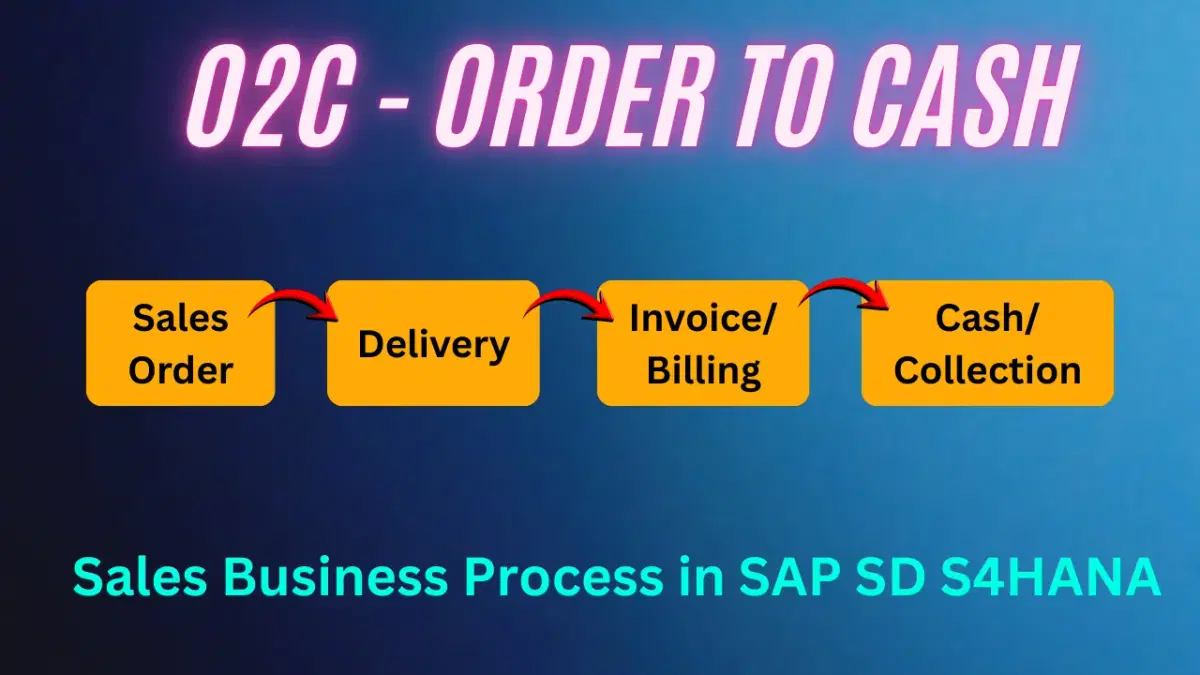
Order to Cash process in sap. Simple explanation of OTC process for professionals working in sales operation.
SAP SD stands for sales and distribution module in sap which manages the sales functionalities in the business. This module is also known as ‘O2C’ which means ‘Order-to-Cash’.
Among all business processes, order to cash is the most critical business process in an organiation.
It is absolutely the way you do your purchases – be it online or offline! Let’s say you want to buy a T-shirt of size ‘M’. You will place on ORDER to the seller. Seller will check for the availability and then will make a DELIVERY of that order to you directly Or to your addressif you are at a distant location. Now, he is not doing it for free right! So he will also send us the INVOICE mentioning the billing amount that he will be charging you for a T-shirt. It might also contain the shipping charges if applicable and the tax amount. And finally, you will pay the charged CASH or payment to the seller. Isn’t it something that you have experienced already. I am sure the answer would be a “YES” and this is cycle that we revolve around while learning the SD module in detail. Of course, there are various twists and turns in the story as there are multiple scenarios in SD that will mould this cycle as per business requirements, but this remains as a basis that we will have to follow.
I just hope that you got the gist of it. To move a bit ahead and learn more, Order is nothing but a ‘SALES ORDER’ which is a response given to customer’s purchase order as a confirmation that we will supply the goods that they are asking for at the given price and within the given time. After the goods are available, we create an ‘OUTBOUND DELIVERY’ for shipping the goods out to the customer location. Along with the delivery or later we also send out the ‘BILLING DOCUMENT’ or an invoice to charge our customer for the goods that we have supplied. Here the SD documentation generally ends and territory of the finance team starts with an ‘ACCOUNTING DOCUMENT’ which updates the finance team about the revenue to be collected from the customer for the sale that we have made. So it is actually a SD responsibility to make sure that accounting document is created. At last, finance team follows up for the payment with customer and once the customer pays the amount the accounting document is ‘CLEARED’ or in other words marked as paid by the finance team. This completes the transaction that started with an order!
Exciting! Let’s connect together to explore more in a simple way and make a right move towards your IT career.